

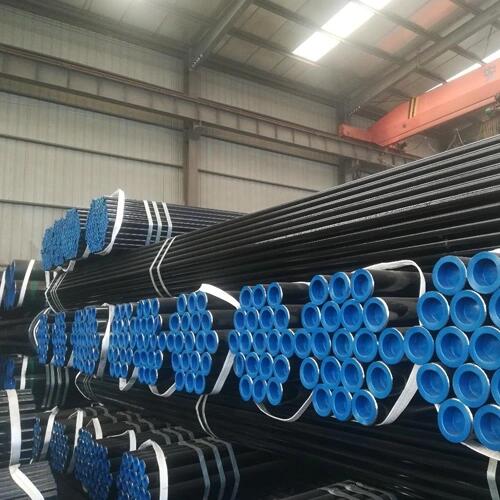
Seamless steel pipes (smls pipe) are pipes manufactured by piercing and rolling solid steel billets. Their manufacturing process eliminates the structural weakness of weld seams. This unique manufacturing method endows seamless steel pipes with a series of excellent performance characteristics, making them an ideal choice for high-temperature applications.
Mechanism analysis of the high-temperature resistance of seamless steel pipes:
1. Uniform material microstructure
Seamless steel pipes have a uniform crystal structure and chemical composition distribution throughout the entire pipe body. This uniformity ensures that the material's thermal expansion coefficient, thermal conductivity, and other performance parameters remain consistent in high-temperature environments, avoiding thermal stress concentration problems caused by local performance differences.
2. Structural Advantages of Seamless Steel Pipes
Welded joints are often weak points in piping systems, prone to thermal fatigue, creep, and oxidation under high-temperature conditions. Seamless steel pipes completely eliminate this risk; their continuous and uniform structure better withstands various stresses brought about by high temperatures.
3. Optimized Alloy Design
Seamless steel pipes used in high-temperature environments typically employ special alloy formulations, such as the addition of elements like chromium (Cr), molybdenum (Mo), and vanadium (V). These alloying elements can increase the recrystallization temperature of the steel, forming stable carbides, thereby enhancing the material's strength and oxidation resistance at high temperatures.
Specific Performance of Seamless Steel Pipes in High-Temperature Environments:
1. Excellent High-Temperature Strength
Seamless steel pipes maintain high mechanical strength even at high temperatures. Taking the common P91 alloy steel seamless pipe as an example, its yield strength at 600°C can still reach over 200 MPa, far exceeding that of ordinary carbon steel. This high-temperature strength allows seamless steel pipes to withstand high-temperature and high-pressure working conditions.
2. Good Creep Resistance
Under prolonged high-temperature conditions, metallic materials undergo slow plastic deformation (creep). Seamless steel pipes, through rational alloy design and heat treatment processes, significantly improve creep resistance. For example, adding molybdenum can hinder dislocation movement and improve the material's creep resistance.
3. Excellent Oxidation and Corrosion Resistance
At high temperatures, metal surfaces easily react with oxygen to form oxide scale. The chromium added to seamless steel pipes forms a dense Cr₂O₃ protective film on the surface, effectively preventing further oxygen diffusion. In high-temperature environments containing corrosive media such as sulfur, seamless steel pipes also exhibit superior corrosion resistance compared to welded pipes.
4. Stable Thermophysical Properties
Seamless steel pipes possess a uniform coefficient of thermal expansion and thermal conductivity, maintaining dimensional stability under temperature changes and reducing thermal stress. This is particularly important for the thermal cycling conditions of high-temperature equipment, effectively preventing thermal fatigue damage.
Seamless steel pipes are typically made of high-quality carbon steel, alloy steel, or stainless steel, materials that inherently possess good heat resistance. The seamless structure avoids the heat-affected zone and potential defects that can result from welding, allowing the pipe to maintain better integrity and stability at high temperatures.Please feel free to contact us if you have any questions.Email : pipe@stpipefitting.cn.
 How to Choose Carbon Steel Pipe Size?
 DIN 1629 St37 St52 Seamless Steel Pipes
 Boiler Tube Size Chart
 API 5L SSAW Steel Pipe Definition and Grades

