What is the cause of transverse crack on the surface of seamless steel pipe

Views : 2783
Update time : 2023-01-13 09:19:26
  Under the corresponding mechanical conditions, various factors that reduce the plasticity of ASTM A335 P5 Seamless Steel Pipe during processing will increase the chances of internal transverse cracks. Therefore, annealing quality and elimination of hydrogen embrittlement are very important in the production of thick-walled seamless steel pipe.

  In addition to the additional stress in the axial direction, there are additional stress in the tangential direction in the process of empty drawing. Longitudinal crack is caused by additional tangential tension stress produced during pull-out.

  Hebei shengtian pipe-fitting group Co., ltd is usually used if there is no special requirement. Seamless steel pipe is made of No. 20 steel, which is not hardened and has no tempering brittleness. The cold deformation has high plasticity and is generally used for bending, calendering, bending and hammer arch processing. The welding performance of arc welding and contact welding is very good, and the thickness of gas welding is relatively small. Generally, it is used for manufacturing under conditions of low pressure resistance but high toughness requirement.

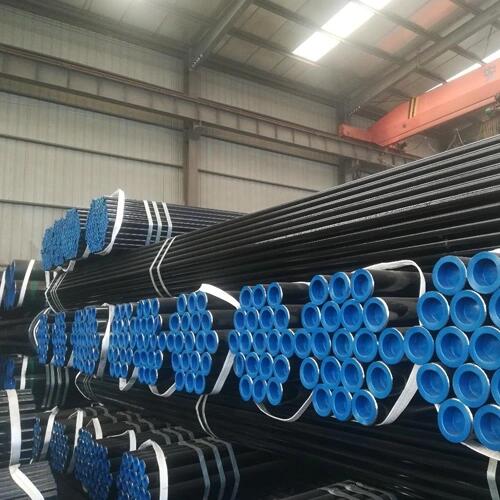
  Seamless steel pipe is made of ingot or solid billet through perforation, and then hot-rolled, cold-rolled or cold-drawn. Seamless steel pipe plays an important role in China's steel pipe industry. It is also one of the advantages of the seamless steel pipe that its manufacturing process is rigorous and it is not allowed to make a millimeter difference outside the specified scope.

Related News
Read More >>
Working Pressure of Seamless Steel Pipe Working Pressure of Seamless Steel Pipe
Sep .17.2026
  Seamless steel pipe actual bearing pressure may be affected by many factors such as the quality of the pipe, processing technology, and use environment Please feel free to contact us if you have any questions Email : pipe@stpipefitting.cn
(SMLS pipe) is a type of pipe produced without welds by deforming the metal as a whole using piercing and rolling techniques. Compared to welded steel pipe, its core advantage stems from the continuity of the material and the uniformity of its structure, providing superior reliability and safety under high pressure, high temperature, and complex stress environments. This makes seamless steel pipe a fundamental and reliable material in the petroleum, chemical, natural gas, and power industries for critical processes and the transportation of hazardous media.
Seamless carbon steel pipe Sch 40 Seamless carbon steel pipe Sch 40
Sep .15.2026
Seamless Carbon Steel Pipe Sch 40 (Schedule 40) is a seamless steel pipe specification that meets the American standard. Its pipe wall thickness is Sch40 (corresponding to the standard wall thickness series), which represents the standard wall thickness under a specific pressure level and is often used in occasions with higher pressure and temperature.
Schedule 80 Carbon Steel Pipe: Thickness, Dimensions & Weight in mm Schedule 80 Carbon Steel Pipe: Thickness, Dimensions & Weight in mm
Sep .10.2026
Schedule 80 Carbon Steel Pipe is made up of carbon steel materials. The carbon steels can vary in composition based on the grades. The strengths and the toughness vary. To have an international and equal identification of the pressure capacities of the pipes, the schedule scale is used. The wall thickness grades of the steel pipe range from Schedule (SCH) 5 to Schedule (SCH) 160. SCH 5 has the lowest pressure resistance, while SCH 160 has the highest.
Steel Pipe Sizes Explained: NPS, OD and Wall Thickness Steel Pipe Sizes Explained: NPS, OD and Wall Thickness
Sep .08.2026
Steel pipe sizing can be confusing, especially for buyers who are new to piping specifications. A pipe's designated size often differs from its actual dimensions, which can lead to mistakes during purchasing or design.