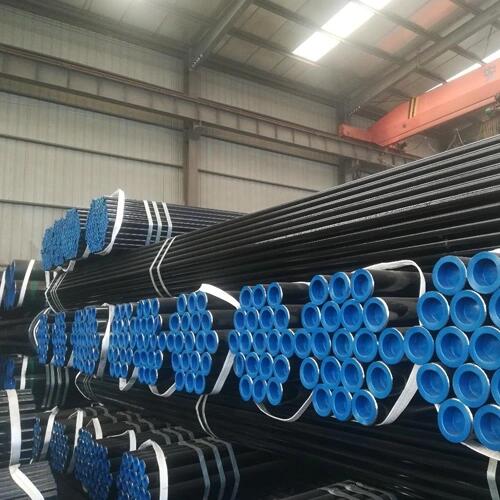
Why should seamless steel pipe be strictly selected

Views : 2663
Update time : 2023-01-28 09:32:22
  First of all, we know that there are many types of seamless steel pipes. High pressure boiler pipe is one of them. The use of high-pressure boiler pipe is often in high-temperature and high-pressure conditions for a long time. The pipe will undergo oxidation and corrosion under the action of high-temperature flue gas and steam. That is to test whether our steel pipe has long-term temperature, anti-oxidation and anti-corrosion performance, and has a good organizational stability.

  Considering how he selects materials, we must first consider the product advantages and focus on quality, strictly select materials and real materials, so that when dealing with craft products, through strict selection, the production of real materials, the product bearing capacity of the selected products must be good, stable and solid, not easy to deform, with mature technology, quality assurance, sufficient inventory, timely delivery, cutting and smooth incision, Good bearing capacity, not easy to deform, various product specifications, strict selection of materials and quality assurance.

  The seamless steel pipe also needs to pay attention to two ends. Due to the structure of the detection device, when the reserved cutting allowance at both ends is small, there is likely to be cracks or other missing parts at the end. If there is a tendency of cracks at the end, it will lead to crack propagation in a later installation.

  Therefore, we should pay attention to a crack detection of seamless steel pipe, which is a very important link. When it comes to the dimensional change of high-pressure boiler caused by thermal expansion and cold contraction, there are two most common types: Rubber high-pressure boiler and metal high-pressure boiler tube.

Related News
Read More >>
Working Pressure of Seamless Steel Pipe Working Pressure of Seamless Steel Pipe
Sep .17.2026
  Seamless steel pipe actual bearing pressure may be affected by many factors such as the quality of the pipe, processing technology, and use environment Please feel free to contact us if you have any questions Email : pipe@stpipefitting.cn
(SMLS pipe) is a type of pipe produced without welds by deforming the metal as a whole using piercing and rolling techniques. Compared to welded steel pipe, its core advantage stems from the continuity of the material and the uniformity of its structure, providing superior reliability and safety under high pressure, high temperature, and complex stress environments. This makes seamless steel pipe a fundamental and reliable material in the petroleum, chemical, natural gas, and power industries for critical processes and the transportation of hazardous media.
Seamless carbon steel pipe Sch 40 Seamless carbon steel pipe Sch 40
Sep .15.2026
Seamless Carbon Steel Pipe Sch 40 (Schedule 40) is a seamless steel pipe specification that meets the American standard. Its pipe wall thickness is Sch40 (corresponding to the standard wall thickness series), which represents the standard wall thickness under a specific pressure level and is often used in occasions with higher pressure and temperature.
Schedule 80 Carbon Steel Pipe: Thickness, Dimensions & Weight in mm Schedule 80 Carbon Steel Pipe: Thickness, Dimensions & Weight in mm
Sep .10.2026
Schedule 80 Carbon Steel Pipe is made up of carbon steel materials. The carbon steels can vary in composition based on the grades. The strengths and the toughness vary. To have an international and equal identification of the pressure capacities of the pipes, the schedule scale is used. The wall thickness grades of the steel pipe range from Schedule (SCH) 5 to Schedule (SCH) 160. SCH 5 has the lowest pressure resistance, while SCH 160 has the highest.
Steel Pipe Sizes Explained: NPS, OD and Wall Thickness Steel Pipe Sizes Explained: NPS, OD and Wall Thickness
Sep .08.2026
Steel pipe sizing can be confusing, especially for buyers who are new to piping specifications. A pipe's designated size often differs from its actual dimensions, which can lead to mistakes during purchasing or design.