

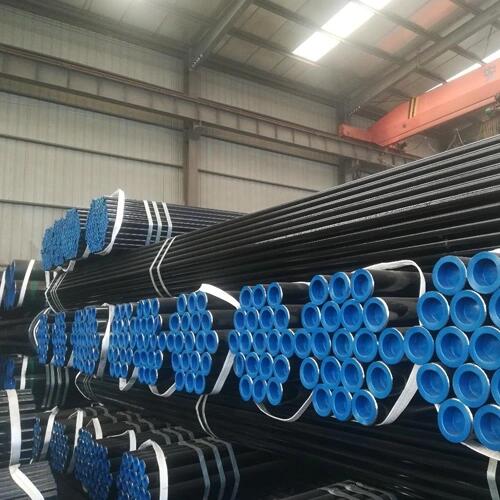
Stainless steel seamless pipe is an important industrial pipe material.Shengtian Group the process, classification, application and other information of stainless steel seamless pipe are carefully summarized:
The manufacturing process of stainless steel seamless pipe mainly includes the following steps:
Hot rolling (extrusion): After the solid tube billet is heated, it is pierced and rolled on the rolling mill, or extruded through an extruder. This is the main method for producing seamless steel pipes, mainly producing steel pipes with larger diameters.
Cold drawing (rolling): Using hot-rolled tubes as raw materials, cold drawing or cold rolling and other cold processing methods are used to further reduce the tube diameter and wall thickness, improve dimensional accuracy and surface finish, and mainly produce small diameter and thin-walled precision steel tubes.
Material classification of stainless steel seamless pipes
Stainless steel seamless pipes can be divided into many types according to their chemical composition and organizational structure. The most common types are:
Austenitic stainless steel: such as 304 (0Cr18Ni9), 316L (00Cr17Ni14Mo2), 321 (1Cr18Ni9Ti), 1.4571 (0Cr18Ni12Mo2Ti), etc., have good corrosion resistance, weldability and processability, and are the most widely used.
Ferritic stainless steel: such as 430 (1Cr17), has good corrosion resistance and thermal conductivity, but poor weldability and plasticity.
Martensitic stainless steel: such as 410 (1Cr13) and 420 (2Cr13), has high strength and hardness, but relatively poor corrosion resistance.
Duplex stainless steel: such as 2205 (00Cr22Ni5Mo3N), which combines the advantages of austenitic and ferritic stainless steels, with high strength, high corrosion resistance and good weldability.
Common standards and grades
American Standard (ASTM)
ASTM A213: Seamless ferritic and austenitic alloy steel pipe for boilers, superheaters, and heat exchangers
ASTM A269: Seamless and welded austenitic stainless steel pipe for general use
ASTM A312: Seamless, welded, and heavily cold-finished austenitic stainless steel pipe
German Standard (DIN)
DIN 17456: Austenitic Stainless Steel Seamless Pipe
DIN 17458: High-Temperature-Resistant Austenitic Stainless Steel Seamless Pipe
Japanese Standards (JIS)
JIS G3446: stainless steel pipe
Main application areas
Petrochemical industry: Pipelines used for transporting corrosive media, oil refining equipment, chemical equipment, etc.
Mechanical manufacturing: Used to manufacture hydraulic supports, bearing sleeves, cylinders and other mechanical parts.
Aerospace: Used to manufacture aircraft structures, engine components, etc.
Food industry: used in food processing equipment, beverage production lines, etc.
Pharmaceutical industry: used in pharmaceutical equipment, bioengineering, etc.
Energy industry: used in nuclear power plants, power plants, etc.
Architectural decoration: used for interior and exterior decoration, handrails, railings, etc. of high-end buildings.
Stainless steel seamless pipe excellent corrosion resistance, high strength and good processing performance, it is widely used in the fields of petroleum, chemical industry, medicine, food, aerospace, etc. Compared with welded steel pipe, seamless steel pipe has no weld seam, so it has higher pressure bearing capacity and better safety.
 How to Choose Carbon Steel Pipe Size?
 DIN 1629 St37 St52 Seamless Steel Pipes
 Boiler Tube Size Chart
 API 5L SSAW Steel Pipe Definition and Grades

