

In the field of pipelines, Schedule 40 pipe is widely used, especially in water and gas piping applications. These pipes are known for their mechanical strength, wide temperature range and strong pressure resistance capabilities. Understanding the intricacies of pressure ratings is critical to ensuring optimal performance of Schedule 40 pipe.
1. Diverse Steel Pipe Schedules
Within the spectrum of steel pipes, there exist 14 different schedules, each designed to meet specific requirements. Schedule 40, being the standard and widely used option, holds a special place in the construction and plumbing industries. The schedule number plays a pivotal role, influencing both wall thickness and pressure ratings, and is standardized by the American Society of Mechanical Engineers (ASME).
2. Dimensions and Specifications
For clarity and consistency in construction, ASME B36.10 standardizes dimensions for wrought steel pipes, while ASME B36.19 does the same for stainless steel pipes (SCH 40S). Detailed tables provide insight into the dimensions and weights of Schedule 40 pipes, aiding in precise installations.
3. Pressure Rating Formula
The Schedule number is a key factor in determining a pipe's stress-bearing capacity and its ability to withstand pressure. The pressure rating formula, expressed as SCH * P = S, where SCH represents the schedule number, P is the maximum internal pressure, and S is the allowable stress, provides a systematic approach to assessing pressure capabilities.
4. Advanced Pressure Rating Calculation
Delving into the intricacies of pressure rating calculation involves a modified Barlow’s formula. Rearranged to consider factors such as pipe wall thickness, outside diameter, allowable pressure, stress, longitudinal-joint quality, and wall thickness correction, this advanced approach ensures a thorough understanding of a pipe's pressure-bearing capabilities.
5. Stainless Steel Pressure Rating Dynamics
Schedule 40 stainless steel pipes introduce additional complexities due to the material's unique properties. Barlow’s formula, when applied to stainless steel, considers the impact of design temperature on allowable stress. The article systematically calculates and tabulates pressure ratings at various temperatures for a comprehensive understanding.
Schedule 40 Pipes Pressure Rating Chart:
The following table presents the Maximum Allowable Pressure (also known as pressure rating) for Schedule 40 pipes across a range of nominal pipe sizes (NPS). The pressure values are shown in psi (pounds per square inch) and kPa (kilopascal), reflecting common units used globally.
Maximum Allowable Pressure (psi) (kPa)
NPS (inch)Outside Diameter (inch)/(mm)Schedule 40
|
Maximum Allowable Pressure (psi) (kPa) |
||
|---|---|---|
| NPS (inch) | Outside Diameter (inch)/(mm) | Schedule 40 |
| 1/4 inch | 0.54 inch 13.7 mm |
7985 55057 |
| 3/8 inch | 0.675 inch 17.1 mm |
6606 45548 |
| 1/2 inch | 0.84 inch 21.3 mm |
6358 43838 |
| 3/4 inch | 1.05 inch 26.7 mm |
5273 36357 |
| 1 inch | 1.315 inch 33.4 mm |
4956 34172 |
| 1 1/4 inch | 1.66 inch 42.2 mm |
4133 28497 |
| 1 1/2 inch | 1.9 inch 48.3 mm |
3739 25780 |
| 2 inch | 2.375 inch 60.3 mm |
3177 21905 |
| 2 1/2 inch | 2.875 inch 73 mm |
3460 23857 |
| 3 inch | 3.5 inch 88.9 mm |
3024 20850 |
| 3 1/2 inch | 4 inch 102 mm |
2769 19092 |
| 4 inch | 4.5 inch 114 mm |
2581 17796 |
| 5 inch | 5.563 inch 141 mm |
2273 15672 |
| 6 inch | 6.625 inch 168 mm |
2071 14280 |
| 8 inch | 8.625 inch 219 mm |
1829 12611 |
| 10 inch | 10.75 inch 273 mm |
1664 11473 |
| 12 inch | 12.75 inch 324 mm |
1560 10756 |
| 14 inch | 14 inch 356 mm |
1533 10570 |
| 16 inch | 16 inch 406 mm |
1531 10556 |
| 18 inch | 18 inch 457 mm |
1530 10549 |
| 20 inch | 20 inch 508 mm |
1455 10032 |
| 22 inch | 22 inch 559 mm |
|
| 24 inch | 24 inch 610 mm |
1405 9687 |
| 30 inch | 30 inch 762 mm |
|
| 32 inch | 32 inch 813 mm |
1054 7267 |
| 34 inch | 34 inch 864 mm |
992 6840 |
| 36 inch | 36 inch 914 mm |
1021 7040 |
| 42 inch | 42 inch 1067 mm |
875 6033 |
1 in (inch) = 25.4 mm
1 psi (lb/in2) = 6,894.8 Pa (N/m2) = 6.895x10⁻² bar
How to Calculate Pressure Rating for Schedule 40 Pipes?
The pressure rating can be estimated using the Barlow's formula:
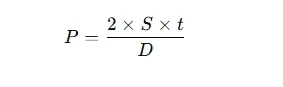
Where:
P = Maximum allowable pressure (psi)
S= Material allowable stress (psi)
t = Wall thickness (inch)
D = Outside diameter (inch)
This formula shows why thicker pipes and stronger materials have higher pressure ratings.
6. Factors Influencing Pressure Ratings
(1) Material Composition
The material composition of Schedule 40 pipes significantly influences their pressure ratings. Common materials include PVC, CPVC, and steel. Each material has distinct properties that affect how well the pipe can withstand pressure.
(2) Temperature Considerations
Temperature plays a crucial role in determining the pressure a Schedule 40 pipe can handle. Different materials exhibit varying temperature resistance, and exceeding the recommended temperature limits can compromise the pipe's integrity.
(3) Pipe Diameter
The diameter of the pipe is another critical factor affecting pressure ratings. Larger-diameter pipes generally have higher pressure ratings, allowing them to handle more substantial fluid loads.
Mastering the pressure ratings of Schedule 40 pipes is a fundamental step in ensuring the success and safety of your plumbing projects. By delving into the intricacies of steel pipe schedules, dimensions, pressure rating formulas, and advanced calculations, this article equips you with the knowledge needed to make informed decisions and construct reliable plumbing systems that stand the test of time.
 API 5L SSAW Steel Pipe Definition and Grades
 How to Calculate MS Pipe Weight: Complete Formula, Chart & Examples
 SAW vs ERW and EFW Welded Steel Pipe
 Stainless Steel Pipe OD and Wall Thickness Explained

