

Carbon steel welded pipes can be divided into three types: Longitudinal submerged arc welded steel pipes (LSAW), Spiral welded steel pipes (SSAW), and Electric resistance welded Steel Pipe (ERW, also called high-frequency straight seam welded steel pipes ) according to the forming method of the weld seam.
Shengtian Group compares these three common welded pipe types to help you choose the right product for your project.Feel free to contact me if you have any questions Email : pipe@stpipefitting.cn
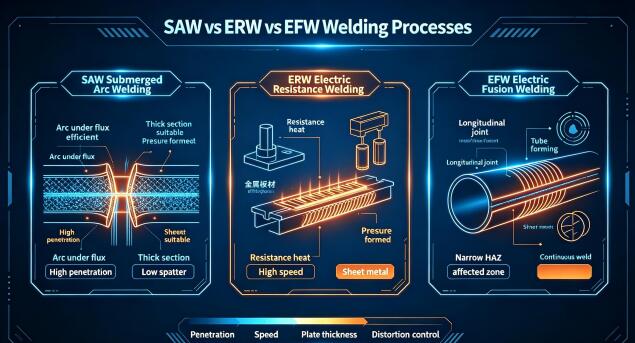
SAW steel pipe (Submerged Arc Welding Steel Pipe), it can be classified into longitudinal submerged arc welding steel pipe (LSAW steel pipe) and spiral submerged arc welding steel pipe (SSAW steel pipe). SAW is a manufacturing process using submerged arc welding of steel,this process produces high current density, which prevents the flux layer from losing heat quickly and concentrates in the welding region. Commonly used standard is API 5L.
Submerged arc weld of high quality, high production efficiency, arc and smoke a few characteristics of submerged arc welded pipe is widely used in pressure vessels,pipe manufacturing, beams, low pressure fluid, steel works.
LSAW Steel Pipe (Longitudinal Submerged Arc Welded Steel Pipe)
Longitudinal submerged arc steel pipe has a weld seam parallel to the longitudinal direction of the pipe. It is made from hot-rolled or cold-rolled steel plates or strips that are curled and welded. The production process is simple, with high efficiency and low cost, and it has developed rapidly.
Applications: Water supply projects, petrochemical industry, chemical industry, electric power industry, agricultural irrigation, and urban construction.
SSAW Steel Pipe (Spiral Submerged Arc Welded Steel Pipe)
Spiral welded steel pipe is made from strip steel coils rolled into tube blanks at a certain spiral angle and then welded. It can use narrow strip steel to produce large-diameter steel pipes.
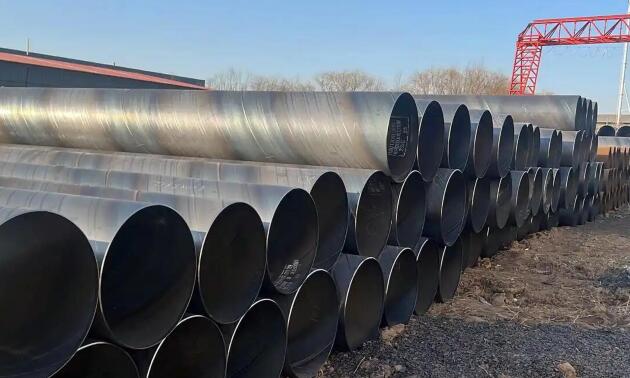
Advantages: The strength of spiral welded pipes is generally higher than that of straight seam welded pipes. Larger diameters can be produced from narrower billets, and different diameters can be produced from billets of the same width.
Disadvantages: Compared with straight seam pipes of the same length, the weld length is increased by 30–100%, and the production speed is lower.
Applications: Drainage and water supply projects, fluid liquid and solid transportation pipelines, urban construction, and municipal engineering.
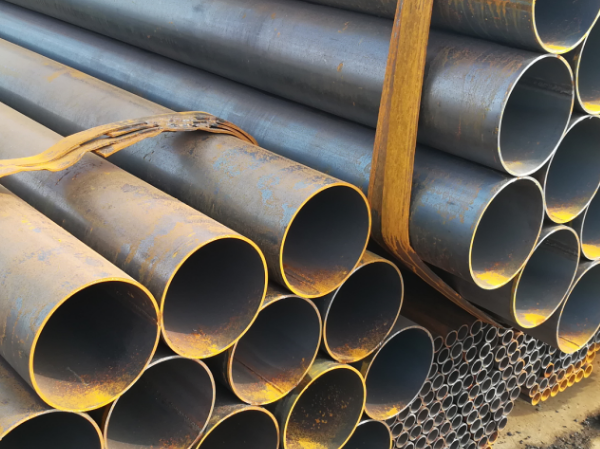
ERW steel pipe (Electric Resistance Welded Steel Pipe) uses the skin effect and proximity effect of high-frequency current to heat and melt the edge of the pipe blank after the hot-rolled coil is formed by a forming machine, and then presses it under the action of squeeze rollers to achieve welding.
Characteristics: High efficiency, low cost, material saving, and easy automation.
Applications: Widely used in aviation, aerospace, energy, electronics, automotive, light industry, and other industrial sectors. It is an important link in the welding process.
EFW steel pipe stands for Electric Fusion Welded steel pipe. EFW is a category of fusion welding processes that use an electric arc to melt and join metals with a filler metal, without applying pressure. For pipe manufacturing, the most common EFW process is Submerged Arc Welding (SAW).
EFW pipe is made by rolling a steel plate into a cylindrical shape and welding the longitudinal seam. The weld flash can be removed, and the weld zone can be heat-treated to refine the structure and make the seam less visible.
Characteristics:
High weld quality and deep penetration
Weld zone can be heat-treated for better toughness
Tighter dimensional tolerances than seamless pipe
Suitable for large-diameter, thick-wall pipes
Standard of EFW steel pipe: ASTM A671, ASTM A672
Applications: Refineries, petrochemical plants, LNG terminals, and long-distance pipelines.
SAW vs ERW vs EFW: Quick Comparison
The table below provides a side-by-side comparison of SAW, ERW, and EFW welded pipes across key aspects including manufacturing process, weld quality, applications, and cost to help you quickly identify the differences.
| Feature | SAW (LSAW / SSAW) | ERW | EFW |
|---|---|---|---|
| Welding Method | Submerged Arc Welding | Electric Resistance Welding (High-frequency welding) | Electric Fusion Welding |
| Weld Seam Type | Longitudinal (LSAW) or Spiral (SSAW) | Longitudinal straight seam | Longitudinal straight seam |
| Typical Size Range | LSAW: medium to large; SSAW: large diameters | Small to medium (up to 24") | 6" to 100" diameter |
| Weld Quality | High quality, flux-protected | Smooth, flat weld seam | High quality, deep penetration |
| Production Speed | LSAW: moderate; SSAW: lower | High | Moderate |
| Cost | LSAW: higher; SSAW: moderate | Lower | Higher |
| Residual Stress | Higher | Lower | Very low |
| Common Applications | LSAW: high-pressure oil/gas; SSAW: low-pressure water/drainage | Building structures, water/gas lines, automotive | Refineries, fertilizers, LNG terminals, critical applications |
| Key Standards | API 5L | API 5L, ASTM A53, GB/T 3091 | ASTM A671, ASTM A672 |
Performance Comparison – ERW vs SAW
The following table provides a detailed performance comparison between ERW and SAW welded pipes, covering surface quality, weld defects, residual stress, and overall durability.
| Comparison Aspect | ERW Steel Pipe | SAW Steel Pipe (LSAW / SSAW) |
|---|---|---|
| Surface Quality | Weld seam is flat, smooth, and better than SAW pipes. | Weld reinforcement is noticeable internally and externally. |
| Weld Defect Types | Fewer defect types (only straight welds and wire-line), easy to inspect. | More defect types due to solvent deposition. |
| Residual Stress Ratio | Lower residual stress due to more thorough deformation during forming, plus subsequent sizing, flattening, and necking. | Higher residual stress. |
| Overall Durability | More durable. If defective, steel scrap and re-welding can be done without cracking or corrosion. | If defective, re-welding may result in cracking or corrosion. |
| Service Pressure | Suitable for low to medium pressure. | LSAW: medium to high pressure; SSAW: low pressure. |
| Cost | Lower | SSAW: lower than LSAW; LSAW: higher |
Manufacturing Process Differences:
SAW Welded Pipe Manufacturing Process:
● In single-seam SAW welded pipe, submerged arc welding is used. A welding arc is submerged in welding flux, and a continuous solid filler wire is input from the outside. The pipe is double-welded, first inside and then outside.
● In double-seam SAW welded pipe, the two halves are connected by tack welding (fit-up), resulting in two opposite weld seams. Both seams are welded from inside and outside.
● In spiral SAW welded pipe, the steel plate is formed in a spiral loop and then welded from inside and outside.
ERW Welded Pipe Manufacturing Process:
Two disc-shaped copper electrodes apply pressure and current, rotating as the material passes between them. This allows constant contact to make long continuous welds.
EFW Welded Pipe Manufacturing Process:
EFW (Electric Fusion Welding) pipe is manufactured by rolling steel plate into a cylindrical shape and welding the longitudinal seam using Submerged Arc Welding (SAW) or Gas Metal Arc Welding (GMAW). A filler metal is used, and no pressure is applied. The weld flash can be removed from the outside or inside surfaces using a scarfing blade, and the weld zone can be heat-treated to refine the grain structure and minimize visible seams. This process enables deep penetration welding with good weld quality.
Key Equipment for Large-Diameter EFW Pipe Production:
The manufacturing of large-diameter, thick-wall EFW pipes for critical applications requires specialized equipment, including 1600MT press brake machine, multiple rolls bending machine, welding installations for outside, inside and circumferential welding, size calibrating press, solution annealing furnace, and a host of other related machinery.
These facilities enable the production of pipes used in demanding environments such as refineries, fertilizer plants, LNG terminals, and cross-country pipelines.
SAW vs EFW – Key Additional Differences
The following table highlights additional differences between SAW and EFW that are not covered in the main comparison table above, focusing on welding principles and material compatibility.
| Comparison Aspect | SAW (LSAW / SSAW) | EFW |
|---|---|---|
| Welding Principle | Arc submerged in flux layer, uses consumable electrode wire. | Arc between electrode and workpiece melts base metal and filler metal; no pressure applied. |
| Material Compatibility | Primarily suitable for carbon steel and low-alloy steel. | Suitable for carbon steel, low-alloy steel, and some stainless steels |
| Heat-Affected Zone (HAZ) | Relatively wide HAZ, may require post-weld treatment. | Relatively wide HAZ, may require post-weld heat treatment. |
| Operating Environment | Standard workshop environment. | Standard workshop environment. |
How to Choose the Right Welded Steel Pipe?
1. Low-pressure water/gas pipelines, building structures → Choose ERW Pipe (Low cost, high precision).
2. High-pressure oil/gas transmission → Choose LSAW Pipe (Strong weld, API 5L compliant).
3. Large-diameter low-pressure water/drainage → Choose SSAW Pipe (Cost-effective for large diameters).
4. Critical applications (refineries, LNG terminals) → Choose EFW Pipe (Highest weld quality).
FAQs:
Q1: Which is better, ERW or SAW pipe?
A: It depends on the application. ERW is suitable for low/medium pressure, cost-sensitive projects; SAW (especially LSAW) is suitable for high-pressure long-distance oil and gas pipelines; SSAW is suitable for large-diameter low-pressure projects.
Q2: What is EFW pipe used for?
A: EFW pipe is used in critical and harsh environments, such as refineries, fertilizer plants, LNG terminals, and long-distance pipelines, due to its high weld quality and deep penetration.
Q3: Which welded pipe is the most cost-effective?
A: ERW pipe is generally the lowest cost and suitable for large-scale standard applications. SSAW is an economical choice for large-diameter low-pressure projects. LSAW and EFW are more expensive, but their performance advantages are worthwhile in specific scenarios.
ERW, SAW (LSAW/SSAW), and EFW each have distinct advantages and ideal applications. ERW pipe offers the best cost-effectiveness for standard low-to-medium pressure applications. SAW pipe (especially LSAW) is the go-to choice for high-pressure transmission lines, while SSAW provides an economical solution for large-diameter low-pressure projects. EFW pipe is reserved for the most critical and demanding applications where weld quality is paramount Email : pipe@stpipefitting.cn
 API 5L SSAW Steel Pipe Definition and Grades
 How to Calculate MS Pipe Weight: Complete Formula, Chart & Examples
 Stainless Steel Pipe OD and Wall Thickness Explained
 Working Pressure of Seamless Steel Pipe

