

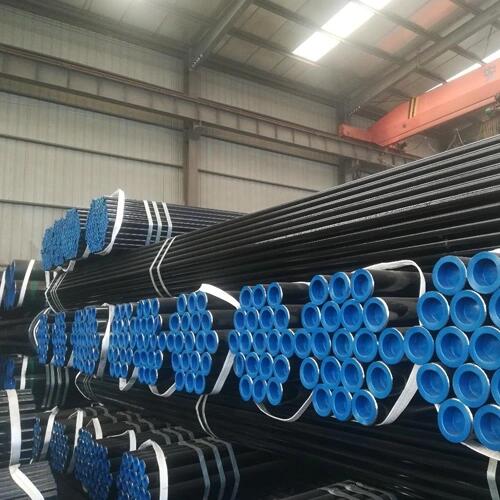
ASTM A53 cold-rolled seamless steel pipe is made by cold rolling at room temperature. During the cold rolling process, the steel pipe undergoes multiple rolling processes without heating, gradually reducing the pipe diameter, and finally forming a high-precision seamless steel pipe.
Since the metal structure does not recrystallize during the cold rolling process, the cold-rolled seamless steel pipe has fine grains, high strength and hardness, and thin walls and high dimensional accuracy. This makes the cold-rolled seamless steel pipe widely used in high-pressure fluid transportation, oil and gas transportation, precision instrument manufacturing and other fields.
Scope of application of cold forming:
Cold-formed ASTM A53 seamless steel pipes are suitable for some mechanical structures, automotive parts, hydraulic transmission systems and other fields. Due to the low cost and fast production speed of the product, it can be mass-produced, so it is widely used in various fields.
The following key factors need to be considered when choosing a suitable ASTM A53 cold-rolled seamless steel pipe:
1. Material selection
There are many types of materials for cold-rolled seamless steel pipes, including carbon steel, alloy steel, stainless steel, etc. Steel pipes of different materials have different characteristics, and factors such as the use environment and use requirements need to be considered when choosing. For example, carbon steel pipes have high strength and toughness, but poor corrosion resistance, and are suitable for some occasions that do not require high corrosion resistance; while stainless steel pipes have good corrosion resistance, but are more expensive, and are suitable for occasions with high material requirements.
2. Size selection
When choosing cold-rolled seamless steel pipes, the size needs to be determined according to the specific use requirements. Including pipe diameter, wall thickness, length, etc. In general, the larger the pipe diameter and wall thickness, the greater the load-bearing capacity, but the cost will also increase accordingly. The length needs to be determined according to the use occasion. For example, in the fields of construction and machinery manufacturing, the length of the steel pipe used is generally shorter.
3. Consider the purpose
The purpose of cold-rolled seamless steel pipes is also one of the factors that need to be considered when choosing. For example, in the fields of petroleum, chemical industry, etc., steel pipes with high corrosion resistance and high temperature performance are needed; in the field of construction, steel pipes with good compressive performance are mainly used; in the field of machinery manufacturing, mechanical parts require steel pipes (mechanical tubing) with high precision, high strength and high wear resistance. Therefore, when choosing cold-rolled seamless steel pipes, specific usage scenarios and requirements must also be considered.
4. Supplier selection
Choosing a suitable supplier is also one of the factors that need to be considered when choosing cold-rolled seamless steel pipes. Generally speaking, high-quality suppliers will guarantee the quality of products, after-sales service, etc., and will also provide more competitive prices. Therefore, when choosing a supplier, it is necessary to comprehensively consider various factors to ensure that high-quality products are selected.
Characteristics and applications of ASTM A53 cold-rolled seamless steel pipes:
The biggest characteristics of cold-rolled seamless steel pipes are no joints, smooth surface, precise size, high strength, strong pressure resistance and corrosion resistance. This makes it widely used in some specific industrial fields. For example, core components such as drive shafts and gasoline injectors in the automotive industry require high-strength and high-precision cold-rolled seamless steel pipes. Similarly, cold-rolled seamless steel pipes are also widely used in high-precision equipment and engineering projects in the fields of aviation, petroleum, and chemical industry.
Advantages of ASTM A53 cold-rolled seamless steel pipes:
Compared with ordinary steel pipes, cold-rolled seamless steel pipes have obvious advantages such as high strength, corrosion resistance, and strong pressure resistance. Its smooth surface, precise size, and no joints make its quality better and can withstand greater pressure and load. In addition, cold-rolled seamless steel pipes do not require welding during the manufacturing process, which makes the finished product have higher overall strength and better safety.
ASTM A53 cold-rolled seamless steel pipe requires considering many factors, including material, size, purpose, etc. When choosing,it is also necessary to choose a high-quality supplier to ensure product quality and after-sales service.
 How to Choose Carbon Steel Pipe Size?
 DIN 1629 St37 St52 Seamless Steel Pipes
 Boiler Tube Size Chart
 API 5L SSAW Steel Pipe Definition and Grades

