

Seamless steel pipe (SMLS) is a type of steel pipe with no seams along its entire length. It is a hollow tube manufactured directly from a single solid steel billet through a complete industrial forming process.
Seamless Steel Pipe Size Range:
Outer Diameter: 1/2 inch - 36 inch (21.3mm-914.4mm)
Wall Thickness: 2.11mm-60mm ( SCH10, SCH20, SCH40, SCH80, STD, SCH120, SCH160, XXS)
Dimensional Parameters of Seamless Steel Pipes:
The dimensional parameters and ranges of seamless steel pipes are a system defined by the outer diameter (OD), wall thickness (WT), and the derived nominal diameter (DN) and wall thickness series (SCH).
1. Outer Diameter Range
a) Small Diameter Seamless Steel Pipe: The outer diameter is typically 6mm-89mm.
Process Characteristics: Cold rolling, cold drawing, or extrusion are often used, making it suitable for applications such as precision machinery components and oil drilling.
b) Medium Diameter Seamless Steel Pipe: The outer diameter is typically 89mm-219mm.
Process Characteristics: Hot rolling is the primary method, with some cold rolling or cold drawing also used. It is used for pipelines, chemical equipment, and other applications.
c) Large Diameter Seamless Steel Pipe: The outer diameter is typically 219mm or larger.
Process Characteristics: Hot rolling and hot expansion are the primary methods, with wall thicknesses up to 200mm. It is primarily used for boiler pipes and large structural components.
2. Wall Thickness Range
Conventional wall thicknesses are divided into three categories:
Standard wall thickness series: SCH 5S to SCH 160
Extra-heavy weight series: XS/XXS
SCH 40 (STD): Standard weight, most commonly used.
SCH 80 (XS): Extra-heavy weight, used for higher pressures.
SCH 160 (XXS): Extra-heavy weight, used for high-pressure pipes.
This is the most commonly used international method for indicating pressure ratings, designated as SCH. For the same outer diameter, the larger the number after the Sch, the thicker the wall thickness and the higher the pressure capacity. Common series: SCH 10, SCH 20, SCH 40, SCH 80, SCH 120, SCH 160.
Special wall thickness series:
Thin-wall seamless steel pipe: Wall thickness typically ranges from 0.25 mm to 6 mm.
Thick-wall seamless steel pipe: Wall thickness typically ranges from 6 mm or greater, with some reaching 50 mm or greater.
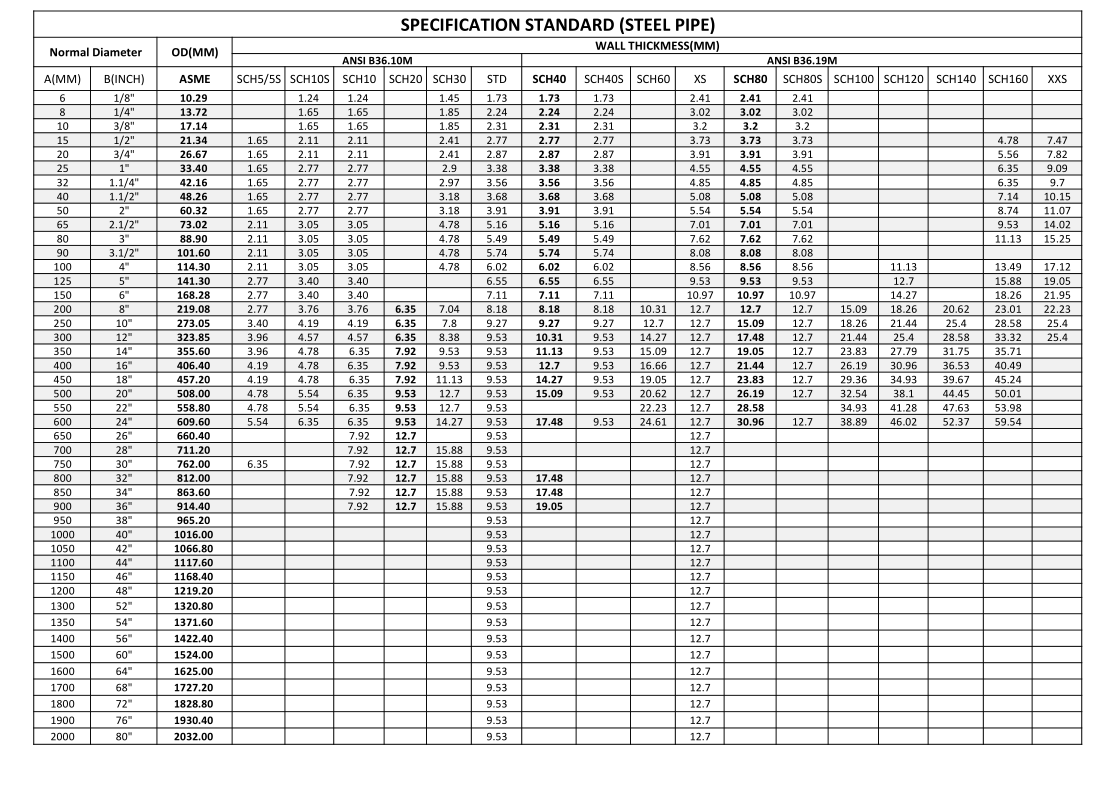
General size table for Seamless steel pipes in mm:
 3. Length Range
Fixed Length: Three standard lengths are commonly available: 6 meters, 9 meters, and 12 meters.
Multiple Lengths: Specific multiple lengths are produced to order.
Special Lengths: Determined based on production conditions, typically ranging from 4 meters to 12 meters, or custom lengths can be made upon agreement.
4. Common Specifications
Small Diameter: Examples include Φ25×2.5, Φ32×3, and Φ57×3.5.
Medium Diameter: Examples include Φ89×4, Φ108×4.5, and Φ159×6.
Large Diameter: Examples include Φ219×8, Φ273×10, and Φ325×12.
5. Standards
International Standards: ASTM A106, ASTM A53, API 5L, etc.
Chinese Standards: GB/T 8162, GB/T 8163, GB/T 3087, GB/T 5310, etc.
Different Types of Seamless Steel Pipe Sizes:
1. Seamless Carbon Steel Pipe
API 5L GR.B, X42, X52, X56, X60, X65, X70 PSL1 & PSL2
Seamless carbon steel pipe size range: 2" - 26" (60.3mm-660mm)
Seamless carbon steel pipe schedules: STD, SCH100, SCH120, SCH160, XXS
Used in the oil and gas industry for natural gas, water, transportation, or offshore drilling platforms.
ASTM A106 GR.B, ASTM A53 GR.B
Seamless carbon steel pipe size range: 1/2" - 36" (21.3mm-914.4mm)
Seamless carbon steel pipe schedules: SCH10, SCH20, STD, SCH40, SCH60, XS, SCH80, SCH100, SCH120, SCH160, XXS
Used in a variety of applications from structural support to steam drum headers, with a temperature range up to 800°F (approximately 404°C).
2. Seamless Stainless Steel Pipe
Seamless Stainless Steel Tube Outer Diameter Range: 1/8" - 24" (10.29mm - 609.6mm)
Seamless Stainless Steel Tube Wall Thickness Range: Sch5S, Sch10S, Sch20S, Sch40S, Sch80S, Sch120, Sch160, XXS
Material Steel Grades: TP 304L/H, 316L/H, 309/S, 310/S, 317/L, 321/H, 347/H, 904L, 2205, 2507
Standards: ASTM A312, ASTM A213, ASTM A358, ASTM A813, ASTM A814
3. Seamless Boiler Tube
Seamless Boiler Tube Outer Diameter (OD) Range: 10mm to 510mm
Seamless Boiler Tube Wall Thickness (WT) Range: 1.5mm to 26mm
Common Standards: ASTM A106, ASTM 179, ASTM A192, ASTM A213, ASTM A333, ASTM A335
4. Seamless Mechanical Tube
Seamless Mechanical Tubing OD Range: 6mm-350mm
Seamless Mechanical Tubing Wall Thickness Range: 0.5mm-25mm
Length: High-precision cut-to-length, commonly 1-8 meters, or precision cut-to-length.
Process: High-precision, primarily cold drawing/cold rolling.
Used for manufacturing mechanical parts, emphasizing precision, performance, and processability.
Common Standards: ASTM A519, DIN 2391, GB/T 3639
5. Seamless Structural Tube
Seamless Structural Tubing OD Range: 35mm-1060mm
Seamless Structural Tubing Wall Thickness Range: 3mm-120mm
Length: Cut-to-length or multiple lengths, commonly 6 meters, 9 meters, and 12 meters.
Process: Standard precision, primarily hot rolling. As a component of architectural/engineering structures, it emphasizes overall strength and stability.
Common standards: ASTM A500, ASTM A501, GB/T 8162
Standard Pipe Sizes of Seamless Steel Pipe in inch:
| Seamless Steel Pipe Sizes | Seamless Steel Pipe Schedule (inch) | |||||||||||||
| INCH | 5S | 5 | 10S | 10 | 20 | 30 | 40 | STD | 60 | 80 | 100 | 120 | 140 | 160 |
| 1/8 | 0.035 | 0.049 | 0.049 | 0.068 | 0.068 | 0.095 | ||||||||
| 1/4 | 0.049 | 0.065 | 0.065 | 0.2447 | 0.2447 | 0.3145 | ||||||||
| 3/8 | 0.048 | 0.065 | 0.065 | 0.091 | 0.091 | 0.126 | ||||||||
| 1/2 | 0.065 | 0.065 | 0.083 | 0.083 | 0.109 | 0.109 | 0.147 | 0.187 | ||||||
| 3/4 | 0.065 | 0.065 | 0.083 | 0.083 | 0.113 | 0.113 |
0.154 |
0.218 | ||||||
| 1 | 0.065 | 0.065 | 0.109 | 0.109 | 0.133 | 0.133 | 0.179 | 0.250 | ||||||
| 1 1/4 | 0.065 | 0.065 | 0.109 | 0.109 | 0.140 | 0.140 | 0.191 | 0.250 | ||||||
| 1 1/2 | 0.065 | 0.065 | 0.109 | 0.109 | 0.145 | 0.145 | 0.200 | 0.281 | ||||||
| 2 | 0.065 | 0.065 | 0.109 | 0.109 | 0.154 | 0.154 | 0.218 | 0.344 | ||||||
| 2 1/2 | 0.083 | 0.083 | 0.120 | 0.120 | 0.203 | 0.203 | 0.276 | 0.375 | ||||||
| 3 | 0.083 | 0.083 | 0.120 | 0.120 | 0.216 | 0.216 | 0.300 | 14.32 | ||||||
| 3 1/2 | 0.083 | 0.083 | 0.120 | 0.120 | 0.226 | 0.226 | 0.318 | |||||||
| 4 | 0.083 | 0.083 | 0.120 | 0.120 | 0.237 | 0.237 | 0.337 | 0.438 | 0.531 | |||||
| 4 1/2 | 0.247 | |||||||||||||
| 5 | 0.109 | 0.109 | 0.134 | 0.134 | 0.258 | 0.258 | 0.375 | 0.500 | 0.625 | |||||
| 6 | 0.109 | 0.109 | 0.134 | 0.134 | 0.280 | 0.280 | 0.432 | 0.562 | 0.719 | |||||
| 7 | 0.301 | |||||||||||||
| 8 | 0.109 | 0.109 | 0.148 | 0.148 | 0.250 | 0.277 | 0.322 | 0.322 | 0.500 | 0.594 | 0.719 | 0.812 | 0.916 | |
| 9 | ||||||||||||||
| 10 | 0.134 | 0.134 | 0.165 | 0.165 | 0.250 | 0.307 | 0.365 | 0.365 | 0.594 | 0.719 | 0.844 | 1.000 | 1.125 | |
| 11 | ||||||||||||||
| 12 | 0.156 | 0.156 | 0.180 | 0.180 | 0.250 | 0.330 | 0.406 | 0.375 | 0.562 | 0.688 | 0.844 | 1.000 | 1.125 | 1.312 |
| 14 | 0.156 | 0.188 | 0.250 | 0.312 | 0.375 | 0.437 | 0.375 | 0.594 | 0.750 | 0.938 | 1.094 | 1.250 | 1.406 | |
| 16 | 0.165 | 0.188 | 0.250 | 0.312 | 0.375 | 0.500 | 0.375 | 0.656 | 0.844 | 0.1031 | 1.219 | 1.438 | 1.593 | |
| 18 | 0.165 | 0.188 | 0.250 | 0.312 | 0.437 | 0.562 | 0.375 | 0.750 | 0.938 | 1.156 | 1.375 | 1.562 | 1.781 | |
| 20 | 0.188 | 0.218 | 0.250 | 0.375 | 0.500 | 0.594 | 0.375 | 0.812 | 1.031 | 1.281 | 1.500 | 1.750 | 1.968 | |
| 22 | 0.250 | 0.375 | 0.500 | 0.375 | 0.875 | 1.125 | 1.357 | 1.625 | 1.875 | 2.215 | ||||
| 24 | 0.218 | 0.250 | 0.250 | 0.375 | 0.562 | 0.687 | 0.375 | 0.969 | 1.219 | 1.531 | 1.812 | 2.062 | 2.343 | |
| 30 | 0.312 | |||||||||||||
Calculation of Theoretical Weight of Seamless Steel Pipe:
The standard calculation formula for the theoretical weight of seamless steel pipe is:
W=0.02466×S×(D-S) (unit: kg/m)
Wherein, D represents the nominal outer diameter of the steel pipe (mm), and S represents the nominal wall thickness (mm). The coefficient 0.02466 is derived from the density of steel (7.85g/cm³) and unit conversion, and is applicable to common materials such as carbon steel and alloy steel.
Calculation example:
Take a seamless steel pipe with an outer diameter of 60mm and a wall thickness of 4mm as an example:
W = 0.02466 × 4 × (60 - 4) = 5.52kg/m.
Notes:
Deviation between theoretical value and actual value: Due to the dimensional error allowed by the production process (such as wall thickness deviation), the theoretical weight is only used as an estimated reference.
Adjustment of special materials: Materials with large density differences such as stainless steel need to adjust the coefficient value, and the calculation formula needs to be multiplied by the ratio of the material density to 7.85.
Common ASTM Standards for Seamless Pipes include the following:
ASTM A53/A53M: This is a standard specification for pipe, steel, black and hot-dipped, zinc-coated, welded and seamless, used for general purposes, including galvanized and ungalvanized steel pipes.
ASTM A106/A106M: This is a standard specification for seamless carbon steel pipe for high-temperature or pressure service, typically used for applications above 350°C.
ASTM A312/A312M: This is a standard specification for seamless and welded austenitic stainless steel pipes, suitable for heavily cold-worked austenitic stainless steel tubes.
ASTM A269: This is a standard specification for seamless and welded austenitic stainless steel tubes for general corrosion-resistant and low- or high-temperature service applications.
ASTM A500/A500M: This is a standard specification for cold-formed welded and seamless carbon steel round, square, rectangular, or special shape structural tubes, used for welded, riveted, or bolted structures of bridges and buildings.
ASTM A209: This is a standard specification for seamless carbon steel and alloy steel tubes for use in boiler and superheater applications, suitable for high-temperature and pressure services.
ASTM A213/A213M: This is a standard specification for seamless ferritic and austenitic alloy steel tubes for boiler, superheater, and heat exchanger applications.
ASTM A335/A335M: This is a standard specification for seamless ferritic and austenitic alloy steel tubes for high-temperature service.
Shengtian Group provide any standards & grades steel pipe Email : pipe@stpipefitting.cn
 API 5L SSAW Steel Pipe Definition and Grades
 How to Calculate MS Pipe Weight: Complete Formula, Chart & Examples
 SAW vs ERW and EFW Welded Steel Pipe
 Stainless Steel Pipe OD and Wall Thickness Explained

