

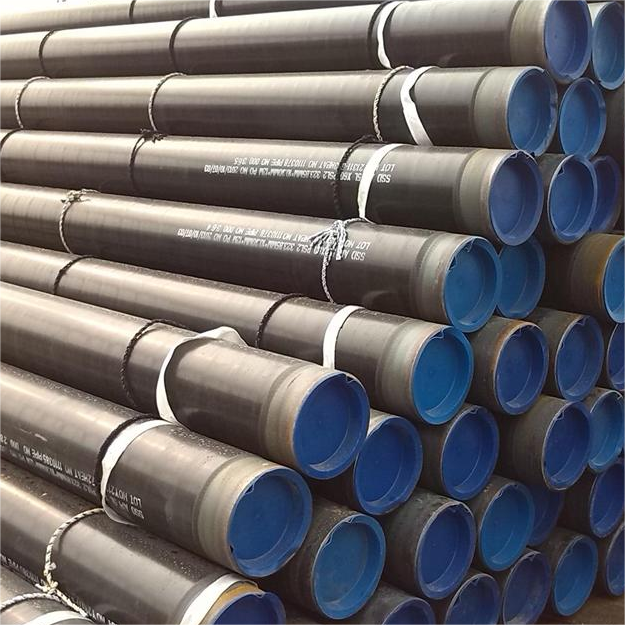
Seamless carbon steel pipe is a steel pipe made by billet heating, perforation, rolling and cooling. Compared with welded steel pipes, seamless steel pipes have obvious advantages in appearance and performance. First of all, it has a smooth appearance and no welded joints, so it has better aesthetics. Secondly, seamless steel pipes excel in strength and pressure resistance and can withstand higher pressures and temperatures. This makes seamless steel pipes widely used in some special fields, such as petroleum, chemical, natural gas and other industries.
What is Schedule 80 ?
The steel pipe wall thickness series comes from the British metrology unit, and the score is used to express the size. The wall thickness of the seamless pipe is made up of the Schedule series (40, 60, 80, 120) and is connected to the weight series (STD, XS, XXS). These values are converted to millimeters as part of the tube wall thickness series.
Schedule 80 seamless carbon steel pipe characteristics:
High pressure resistance, high precision, cold bending deformation, no crack flattening, no oxide scale, good tensile and impact resistance.
Pipe Sch 80 Chart, Dimensions, Weight And Pipe Wall Thickness
| Nominal size [inches] | Outside diameter [inches] | Outside diameter [mm] | Wall thickness [inches] | Wall thickness [mm] | Weight [lb/ft] | Weight [kg/m] |
|---|---|---|---|---|---|---|
| 1/8 | 0.405 | 10.3 | 0.095 | 2.41 | 0.31 | 0.47 |
| 1/4 | 0.54 | 13.7 | 0.119 | 3.02 | 0.54 | 0.8 |
| 1/2 | 0.84 | 21.3 | 0.147 | 3.73 | 1.09 | 1.62 |
| 3/4 | 1.05 | 26.7 | 0.154 | 3.91 | 1.47 | 2.2 |
| 1 | 1.315 | 33.4 | 0.179 | 4.55 | 2.17 | 3.24 |
| 1 1/4 | 1.66 | 42.2 | 0.191 | 4.85 | 3 | 4.47 |
| 1 1/2 | 1.9 | 48.3 | 0.2 | 5.08 | 3.63 | 5.41 |
| 2 | 2.375 | 60.3 | 0.218 | 5.54 | 5.02 | 7.48 |
| 2 1/2 | 2.875 | 73 | 0.276 | 7.01 | 7.66 | 11.41 |
| 3 | 3.5 | 88.9 | 0.3 | 7.62 | 10.25 | 15.27 |
| 3 1/2 | 4 | 101.6 | 0.318 | 8.08 | 12.5 | 18.63 |
| 4 | 4.5 | 114.3 | 0.337 | 8.56 | 14.98 | 22.32 |
| 5 | 5.563 | 141.3 | 0.375 | 9.53 | 20.78 | 30.97 |
| 6 | 6.625 | 168.3 | 0.432 | 10.97 | 28.57 | 42.56 |
| 8 | 8.625 | 219.1 | 0.5 | 12.7 | 43.39 | 64.64 |
| 10 | 10.75 | 273 | 0.594 | 15.09 | 64.43 | 96.01 |
| 12 | 12.75 | 323.8 | 0.688 | 17.48 | 88.63 | 132.08 |
| 14 | 14 | 355.6 | 0.75 | 19.05 | 106.13 | 158.1 |
| 16 | 16 | 406.4 | 0.844 | 21.44 | 136.61 | 203.53 |
| 18 | 18 | 457 | 0.938 | 23.83 | 170.92 | 254.55 |
| 20 | 20 | 508 | 1.031 | 26.19 | 208.87 | 311.17 |
| 24 | 24 | 610 | 1.125 | 30.96 | 296.58 | 442.08 |
Difference Between SCH 40 pipe and SCH 80 pipe:
Pipes with Schedule 40 come with standard weight, and pipes with schedule 80 come with extra strength. The materials used for making Schedule 40 and Schedule 80 come from the same material.
Schedule 80 carbon steel pipes have a thicker wall than Schedule 40 pipes. As such, Schedule 80 pipes are stronger than Schedule 40 pipes. Though both pipes are used in construction work, Schedule 40 is used more often. But if a stronger pipe was needed, then the engineers would go for Schedule 80 pipes. Schedule 80 pipes are used where the pipes have to be exposed. But if there is no need for any extra strength, Schedule 40 pipes are sufficient.
 Pressure rating of stainless steel seamless pipes
 API 5L Pipe Specification: Line Pipe Grades PSL1 & PSL2
 ASTM A53 vs ASTM A106 Carbon Steel Pipe: Key Differences & Selection Guide
 ASTM A53 GR.B ERW Steel Pipe

