

Insulated Steel Pipe is a steel pipe that has undergone insulation processing to ensure that the internal temperature and surface temperature of the working steel pipe meet or reach the required usage temperature under different working environments and external media.
1. Product Structure—Three-Layer Structure
The heat preservation steel pipe has a three-layer integrated structure, consisting of an inner steel pipe for conveying the medium, a middle rigid polyurethane insulation layer, and an outer high-density polyethylene outer protective pipe.
2. Standards Implemented
GB/T 29047-2012 Pre-insulated direct-buried pipes and fittings with high-density polyethylene outer sheath and rigid polyurethane foam
GB/T 34611-2017 Pre-insulated direct-buried pipes with rigid polyurethane spray coating and polyethylene spiral wound
CJ/T 114-2000 Pre-insulated direct-buried pipes with high-density polyethylene outer sheath and polyurethane foam
GB/T 9711-2017 Steel pipes for pipeline transportation systems in the oil and gas industry
SY/T 5037-2018 Submerged arc welded steel pipes for general fluid transportation
GB/T 3091-2015 Welded steel pipes for low-pressure fluid transportation
GB/T 8163-2018 Seamless Steel Pipes for Fluid Transportation
3. Product Specifications
Nominal Diameter: DN100mm-DN1400mm
Pipe Wall Thickness: 5mm-22mm
Steel Grade: Can produce steel pipes of Q series, X70 and below.
4. Product Performance
(1) Wide range of product specifications, applicable to primary and secondary heating pipelines.
(2) Wide applicable temperature range, can operate for extended periods at -50℃-120℃, saving significant energy and reducing energy costs.
(3) Strong waterproof and corrosion-resistant capabilities, while also possessing excellent characteristics such as heat insulation, sound insulation, flame retardancy, cold resistance, non-absorbency, and easy and quick construction. (4) Low coefficient of linear expansion (0.012), resulting in low axial shear strength due to temperature variations. The three-layer integrated structure is stable and will not cause peeling.
(5) Service life can reach 30-50 years. Correct installation and use can minimize pipeline maintenance costs.
(6) An alarm system can be installed to automatically detect pipeline leaks, accurately indicate the location of the fault, and automatically trigger an alarm.
▼Main Technical Indicators of Polyurethane Insulation Layer
|
Project |
Unit |
Index |
Test methods (standards) |
|
Density |
Kg/m3 |
≥60 |
GB/T 6343 |
|
Compressive strength |
MPa |
≥0.3 |
GB/T 8813 |
|
Thermal conductivity |
W/(m·k) |
≤0.033 |
GB/T 10297 |
|
Heat resistance |
℃ |
140 |
EN253 |
|
Closed porosity |
% |
≥88 |
GB/T 10799 |
|
Water absorption rate |
% |
≤10 |
CJ/T 114 |
▼Main technical specifications of thermal insulation pipes
|
Project |
Unit |
Index |
Test methods (standards) |
|
Extrusion deformation |
% |
≤15% |
GB/T 8806 |
|
Outer diameter increase rate |
% |
≤2% |
GB/T 8806 |
|
Impact resistance |
/ |
No visible cracks |
GB/T 14152 |
|
Axial shear strength |
MPa |
≤0.12(23±2) ≤0.08(140±2) |
CJ/T 114 |
5. Schematic diagram of thermal insulation foam production process
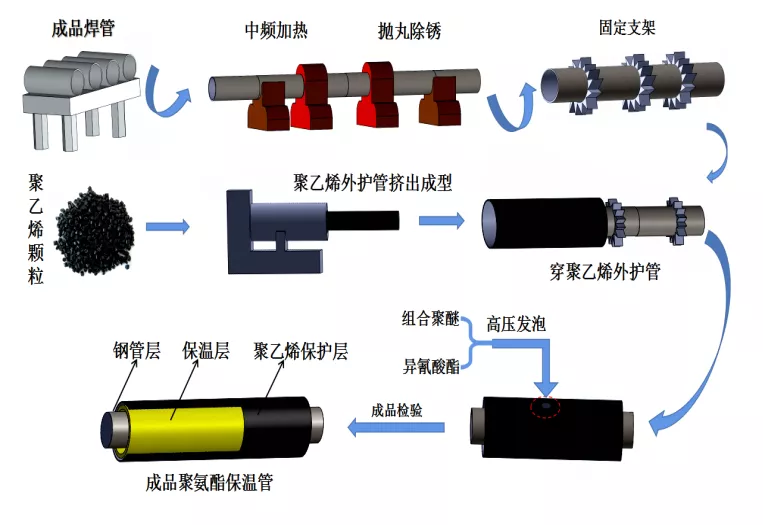
6. Product Specifications and Dimensions
Insulated Steel Pipe Specifications and Dimensions Table
|
Nominal diameter (mm) |
outer diameter of steel pipe (mm) |
Outer diameter of outer sheath × wall thickness(mm) |
Average thickness of insulation layer (mm) |
|
200 |
219 |
315×4.9 |
43 |
|
250 |
273 |
365×6.3 |
40 |
|
300 |
325 |
420×7.0 |
40 |
|
350 |
377 |
500×7.8 |
53 |
|
400 |
426 |
550×8.8 |
53 |
|
450 |
478 |
580×8.8 |
42 |
|
500 |
529 |
655×9.8 |
53 |
|
600 |
630 |
760×11.5 |
53 |
|
700 |
720 |
850×12 |
53 |
|
800 |
820 |
960×14 |
56 |
|
900 |
920 |
1054×14 |
53 |
|
1000 |
1020 |
1155×14 |
54 |
|
1200 |
1220 |
1380×15 |
65 |
|
1400 |
1420 |
1580×16 |
64 |
|
1. Straight pipe supply length: 6-12 meters. 3. Insulation layer thickness can also be customized according to user requirements. |
|||
Insulation projects for various indoor and outdoor centralized heating pipelines, central air conditioning pipelines, chemical and pharmaceutical industrial pipelines. Suitable for media operating at -50℃-120℃ for extended periods, with occasional peak temperatures not exceeding 140℃. Email : pipe@stpipefitting.cn
 API 5L SSAW Steel Pipe Definition and Grades
 How to Calculate MS Pipe Weight: Complete Formula, Chart & Examples
 SAW vs ERW and EFW Welded Steel Pipe
 Stainless Steel Pipe OD and Wall Thickness Explained

