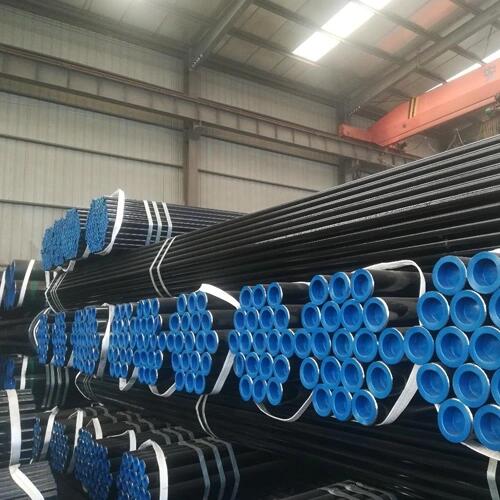
Manufacturing Method of Seamless Steel Pipe

Views : 1148
Author : admin
Update time : 2022-10-26 17:43:03

  Seamless steel pipe can be divided into hot rolled pipe, cold rolled pipe, cold drawn pipe and extruded pipe according to different production methods.

  Hot rolled seamless tubes are generally produced on automatic tube rolling mills. After the solid tube blank is inspected and the surface defects are removed, it is cut to the required length, centered on the end face of the piercing end of the tube blank, then sent to the heating furnace for heating, and punched on the piercing machine. In the process of piercing, the continuous rotation and advance, under the action of the roll and the plug, a cavity is gradually formed inside the tube blank, which is called the blank. Then it is sent to the automatic pipe mill to continue rolling. Finally, the wall thickness is adjusted by the homogenizer, and the diameter is calibrated by the sizing machine to meet the specification requirements. It is an advanced method to produce hot rolled seamless steel pipe by continuous pipe rolling mill.

  In order to obtain seamless tubes with smaller size and better quality, cold rolling, cold drawing or a combination of the two methods must be adopted. Cold rolling is usually carried out on a two high mill. The steel pipe is rolled in an annular pass consisting of a variable cross-section circular groove and a fixed conical plug. Cold drawing is usually carried out on 0.5~100T single chain or double chain cold drawing machine.

  The extrusion method means that the heated tube blank is placed in a closed extrusion cylinder, and the piercing rod and the extrusion rod move together to extrude the extrusion part from the smaller die hole. This method can produce steel pipes with smaller diameters.

Related News
Read More >>
Working Pressure of Seamless Steel Pipe Working Pressure of Seamless Steel Pipe
Sep .17.2026
  Seamless steel pipe actual bearing pressure may be affected by many factors such as the quality of the pipe, processing technology, and use environment Please feel free to contact us if you have any questions Email : pipe@stpipefitting.cn
(SMLS pipe) is a type of pipe produced without welds by deforming the metal as a whole using piercing and rolling techniques. Compared to welded steel pipe, its core advantage stems from the continuity of the material and the uniformity of its structure, providing superior reliability and safety under high pressure, high temperature, and complex stress environments. This makes seamless steel pipe a fundamental and reliable material in the petroleum, chemical, natural gas, and power industries for critical processes and the transportation of hazardous media.
Seamless carbon steel pipe Sch 40 Seamless carbon steel pipe Sch 40
Sep .15.2026
Seamless Carbon Steel Pipe Sch 40 (Schedule 40) is a seamless steel pipe specification that meets the American standard. Its pipe wall thickness is Sch40 (corresponding to the standard wall thickness series), which represents the standard wall thickness under a specific pressure level and is often used in occasions with higher pressure and temperature.
Schedule 80 Carbon Steel Pipe: Thickness, Dimensions & Weight in mm Schedule 80 Carbon Steel Pipe: Thickness, Dimensions & Weight in mm
Sep .10.2026
Schedule 80 Carbon Steel Pipe is made up of carbon steel materials. The carbon steels can vary in composition based on the grades. The strengths and the toughness vary. To have an international and equal identification of the pressure capacities of the pipes, the schedule scale is used. The wall thickness grades of the steel pipe range from Schedule (SCH) 5 to Schedule (SCH) 160. SCH 5 has the lowest pressure resistance, while SCH 160 has the highest.
Steel Pipe Sizes Explained: NPS, OD and Wall Thickness Steel Pipe Sizes Explained: NPS, OD and Wall Thickness
Sep .08.2026
Steel pipe sizing can be confusing, especially for buyers who are new to piping specifications. A pipe's designated size often differs from its actual dimensions, which can lead to mistakes during purchasing or design.